

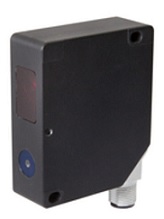
At the Hanover Fair, ipf electronic will be showcasing the PT64 – a new series of diffuse reflection laser triangulation sensors (laser class 2) that have a number of special features with regard to both the device design and the high degree of application flexibility.
When it comes to the virtually color-independent detection of objects in the case of distance measurement or positioning, the PT64 offers an extremely cost-effective solution. The compact devices in their robust metal housing (IP67) have a teach button for determining the start and end point of the measuring range, two LED status indicators, two digital inputs, two analog outputs (0-10 V to 4-20 mA) as well as two digital outputs. A particularly notable design feature is the PT64's connection plug which can be rotated by 180°, allowing the diffuse reflection sensor to be installed in almost any position.
Fresh from the factory, ipf electronic's new products already provide a multitude of basic device functions to ensure easy startup. For example, all PT64 sensors are preconfigured to deliver a distance signal relative to the entire measuring range of the respective device type, whereby the smallest measuring range is 21mm to 45mm and the largest measuring range is 150mm to 1000mm. Moreover, depending on the device type and therefore the measuring range, the diffuse reflection sensors achieve resolutions of 6µm to 250µm.
Two versions with laser spot or laser line
With all PT64 sensors, the user can choose between two versions – one with laser spot and one with laser line. The two versions differ only with respect to the transmission optics.
The PT64 sensors with a dot-shaped laser beam allow extremely exact, pinpoint measurements and are therefore suitable e.g. for distance measurement and positioning of very small objects or for extremely precise measurements at specific positions on components with complex geometries. If, however, rough or irregular object surfaces need to be scanned, it is recommended to use the PT64 sensors that generate a laser line. When a line-shaped laser beam hits such surfaces, a large surface area is scanned by the beam, which improves the reflection of light toward the receiving element and therefore the receive signal of the diffuse reflection sensor. The device versions with laser line are therefore ideal for e.g. measurements on milled or scrubbed metal parts, cast parts or layers of metal wire on coil bodies.
Free software offers even more possibilities
In addition to the diffuse reflection laser triangulation sensors, ipf electronic offers free software which further expands the potential spectrum of practical applications for the new products.
For example, the software can be used to visualize the signal reflected by a surface and then striking the receiving element of a diffuse reflection sensor, thereby allowing the signal quality of a PT64 to be assessed more precisely during distance measurement or positioning.
If the scanning process needs to be determined more precisely for measured value acquisition and evaluation, the two digital inputs of the diffuse reflection sensor can be configured in an extremely application-oriented way using a series of functions already incorporated in the software.
It is also possible to use the software to configure the two analog and digital outputs of the diffuse reflection sensor for specific measuring tasks. Examples for the switching outputs are monitoring whether a limit value or switching point has been overranged or underranged, or checking thresholds, e.g. checking a component height within a previously defined tolerance range.
With the aid of the software, the analog outputs can be used to transfer concrete final values for the measuring range limits to the diffuse reflection sensor. In this context, a special feature of the PT64 is the so-called slave pointer function where the analog outputs output the highest and lowest distance value measured over a measurement cycle. By determining the difference between the two extreme values, the user obtains e.g. a limit value which is to be monitored.
Last but not least, the free software enables function-related parameters of a PT64 to be read out and to be saved on a PC or external data medium.
As a result, all relevant parameters are always reproducible and available at any time.
If at some point a diffuse reflection sensor needs to be swapped out, these parameters can then easily be transferred to the device again using the software, thereby making time-consuming reconfiguration unnecessary.
The PT64 sensors replace the diffuse reflection laser sensors of the PT65 and PT66 model series currently available from ipf electronic. The models from the new series provide users with three devices in a single robust industrial solution: an analog sensor, a switching sensor and a diffuse reflection contrast sensor.